Total Pageviews

Tuesday, August 6, 2024

Roya Heshmati, "Punished with 74 lashes for not covering her hair."


  Thirty-three-year-old, Roya Heshmati was on a mission tonight. She refused to be silent anymore. She had emerged from her protective cocoon throwing off the shackles and chains of fear. Dressed in a black skirt and a red t-shirt, Roya walked out of her apartment, took a deep breath, and courageously walked down the street, at fifteen minutes past 9 pm in Tehran on April 19, 2023. 


  Her evening walk was different from the normal casual walk she was used to doing. Tonight, Roya was raising her voice for the rights of women in Iran. She had just left her apartment, refusing to wear the required hijab when going out publicly. Tonight, she let her soft, black hair dangle freely down over her shoulders in protest of the mandatory hijab law. Roya was joining the thousands of other women in Tehran who were also fearlessly opposing the law, displaying their beauty, and saying no to a dictatorship government. Recently the government had installed surveillance cameras across the cities of Iran to catch violators of the Hijab Law. The new President, Ebrahim Rais, had begun a fierce crackdown campaign against women. The new law warned small businesses they would be shut down if their customers came in without wearing the required veil. Women violators would also lose access to public transportation and have their bank accounts frozen.

    Roya understood the harsh consequences of her actions and yet she knew she could no longer be held captive by fear. Tonight was the night. Her best friend accompanied her and at a designated location on the street, she took a picture of Roya with her back turned toward the camera to protect her identity. Arriving home, Roya quickly logged onto her Facebook account and proudly posted her picture, anxious for all of her female friends to know that she was "out of the closet" and joining them in the uprising. 

   Less than 24 hours later, Roya was rudely awakened from her sleep by a tall chador-clad woman accompanied by officers from the secret police. After forcing their way through the door, the woman pushed her aside impatiently, ordering her to put on a hijab. One of the male officers shouted, "Put something on your head" as they began ransacking through her personal belongings and confiscating her computer.

   Outraged by their behavior, Roya refused their demands, staring intently into their eyes, and shouting, "You came into my house. You can't tell me what to wear!"

    Roya was shocked to discover that in less than 24 hours, her photograph had been identified by the cyber police and now she was being arrested. She gazed down at her bed looking at the nylon socks, black skirt, and red t-shirt lying neatly arranged from the previous night. One of the male officers demanded an explanation for her going out publicly the night before without wearing the required veil. Mustering up the remaining courage from deep down in her soul, Roya proudly and unashamedly stood her ground and replied,

    "I am angry about this endless darkness. I am angry about the constant marginalization and erasure of women. I am infinitely angry about the systematic poisoning of female students. I went out in this attire to reclaim my life and my plundered freedom, even if it was just for a few hours, and I accept the consequences for my actions."

    During her interrogation, Roya was questioned if she understood that she had broken the law, to which she replied, "I know wearing a hijab is the law here, but I question its ethical grounding. We all have to choose between compliance with law enforced by power or acting on what's ethically right."

    When pressed by her interrogator if she regretted her actions, Roya was unwavering and boldly answered, "No. I have the freedom to choose my beliefs and attire. I won't compromise my right. No, I don't regret it!"

    The final verdict of the Islamic Revolutionary and Criminal Court for Roya was one year of suspended imprisonment for propaganda against the regime, 12 years and six months of penal imprisonment, for promoting and encouraging corruption and indecency, and seventy-four lashes for violating public decency, plus a fine for production and distribution of offensive content. After spending eleven days in detention, Roya with the help of her lawyer's appeal, had the 13-year imprisonment reduced to a one-year suspended sentence, leaving only the punishment of seventy-four lashes to endure.


   On the morning of January 3, 2024, Roya was summoned to District 7 court for the penalty of 74 lashes to be carried out. The enforcement officer approached her and directed her to wear the hijab, but she adamantly refused. He then sternly warned Roya that she would be lashed severely, adding another 74 lashes, but Roya bravely stood her ground, refusing to put on the headscarf. Writing later on her Facebook account, Roya described in detail what happened next when she was escorted to the basement for the punishment to be carried out:

  "The iron door squeaked open, revealing a room with cement walls. On the room's floor lay a bed with handcuffs and wielded iron bands on both sides. An easel-like iron device, complete with handcuff places and a rusty iron blind in the center, stood in the room's midst. Additionally, a chair and a small table with an assortment of lashes were behind the door. It resembled a fully medieval torture chamber!"

   The executioner instructed me to remove my coat and lie on the bed. I hung my coat and headscarf at the foot of the torture easel. He insisted, "Put on your headscarf!" I firmly replied that I wouldn't. "Put the Quran under your arm and do what you have to do."

   The man retrieved a black leather lash from the collection, wrapping it around his hand twice as he approached the bed. He began striking my shoulders, back, hips, thighs, and legs. I refrained from counting the strikes. I chanted softly, "In the name of woman, in the name of life, the garments of slavery are torn, our black night will dawn, and all whips will be severed."

   Reading Roya's graphic account of this inhumane torture deeply grieves my soul. I have spent the last eleven years of my life, being a voice for the rights of women in Iran. I have written self-published books telling their stories and doing a weekly podcast called, "The Cross in the Desert," to bring awareness to their struggles for freedom behind the Iron Curtain of the Islamic Republic of Iran. Roya is one of many, brave Iranian women who refuses to compromise her principles, speaking truth to power, and standing up for the precious  God-given gift of freedom, that this dictatorship government refuses to recognize.

   Back in 2013, I wrote a historical fiction novel about a young Iranian violin player named Bahareh, who was secretly performing in an anti-government play entitled, "The Rose of Nowruz." Zealous to be a voice for all of her Iranian friends, she takes part in a public protest during a corrupt presidential election and is tragically gunned down by the militia. One of the powerful songs in my book that is featured in the play, depicts Bahareh, as a courageous freedom fighter who sacrifices her life for the freedom of her friends. 


   As I was reading the powerful account of Roya's lashing, the words to this original song came to mind and I believe it perfectly fits her uncompromising valor in the face of brutality.

    "There is a rose that was silenced, that was crushed. But it will live again. The sun will shine again.

    You gave us hope, gave us freedom, gave us life. Your life will never end. The rose will live again.

    The sun is gonna shine again. The rose is gonna live again.

   Give me wings of freedom so I can fly. I wanna touch the sky. I wanna soar.

   Give me wings of freedom or let me. die. I wanna kiss the sky. I wanna soar!"


   Roya willingly endured every single painful lash, every single torturous blow, for all Iranian women. She wasn't thinking of herself. She was thinking of every oppressed Iranian woman with every strike of the leather whip against her back. Roya patiently endured every severe blow of the leather strap with the undying hope that one day the dawn of freedom will finally arrive and the sun will begin to shine again!


Thursday, August 1, 2024

Angela Carini, "The death of a dream in just 46 seconds."

 The poisonous gender apartheid movement in Iran is a deadly cancer for women. They are banned from attending stadium events, riding bicycles, and forced to wear a hijab when going out publicly. In March of 2019, Sahar Khodayari was arrested when trying to enter a stadium to watch a soccer match, disguised as a woman. A few months later, she set herself on fire on a busy public street in Tehran, protesting the oppression of women in Iran, and died from her injuries a few days later in a hospital ICU ward.


  Here in the states, women aren't banned from spectator sports or from competing. They enjoy the freedom that Sahar desperately desired.  However, there is another "poisonous" movement under the banner of inclusion and fairness that demands that transgender women should be allowed to compete against other women, even though they are biologically male. Women athletes have been extremely vocal about the issues of fairness and safety, being forced to compete against another transgender athlete, proclaiming their sexual identity as a woman, but biologically still a man.

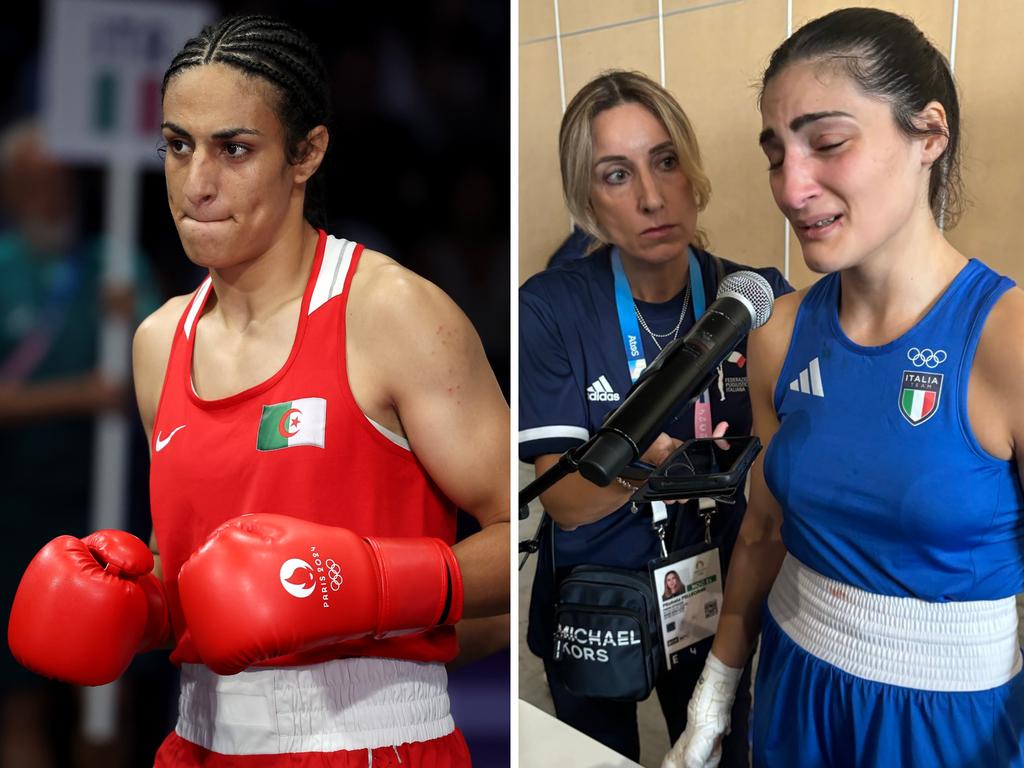
  Twenty-five-year-old Italian boxer Angela Carini trained very hard for many years to realize her Olympic dream, and in just 46 seconds, her dream was shattered. Her opponent, Algerian boxer, Imane Khelif, landed multiple powerful punches, dislodging Carini's chinstrap, and smashing her chin, bloodying her shorts. In fear for her health and safety, Carini returned to her corner and raised her hand, abandoning the fight. She fell to her knees sobbing and refused to shake Khelif's hand after he was declared the winner. Carini later revelaed that she pulled out after being hit harder than she had ever been hit and feared that her nose was broken.

   "I went to the ring to honor my father. I was told a lot of times that I was a warrior but I preferred to stop for my health. I have never felt a punch like this!" 

    Her opponent, Imane Khelif told the BBC, "I am here for the gold. I will fight anybody. I will fight them all."


   Kheliff is one of two boxers permitted to fight at the Olympics despite being disqualified from the women's world championships last year for failing gender eligibility tests. Italian Prime Minister, Giorgia Meloni voiced her opinion amidst the controversy and declared,

 "I think that athletes who have male characteristics should not be admitted to women's competition. And not because you want to discriminate against someone, but to protect the right of female athletes to be able to compete on equal terms."

   Riley Gaines, a former swimmer who competed for the University of Kentucky NCAA swim team has been busy advocating against the inclusion of transgender women in the women's division of sports. In 2022, she lobbied her state representatives to pass a law that would prohibit transgender women from women's sports. She was outraged and quickly took to social media after hearing about Angela Carini's tragic bout in Paris.

   "Angela Carini was punched by a man so hard that she had to back out for the sake of survival. Just like so many domestic violence cases, but now its being encouraged and celebrated. Her entire dream came crushing down at the hands of a man allowed into women's sports. Tragic!"

    Riley is working hard to bring attention to the Biden administration's upcoming changes to Title IX, set to go in effect on August 1. Over the past couple of months, more than 26 states have filed suit against the U.S. Department of Education over the proposed rules changes, arguing that it exceeds the department's authority as a federal agency. The new rules would put women's safety and privacy in jeopardy, allowing men to have full access to women's bathrooms, locker rooms, and changing spaces, as long as they declare that they feel like a woman!

   This policy is disgraceful and harmful to women. Angela Carini's dreams were stolen from her on an Olympic platform that has preached to the world that they believe in fairness and equality in competition. What a lie! What hypocrisy! 


   I love the Olympic games and look forward to them every year, but this year I was appalled! First, the Olympic elite attacked my Christian faith during the opening ceremonies and then they robbed a beautiful young Olympic athlete of her dream to win the gold medal in boxing. We must all stand with Angela Carini and be her voice and demand that Title IX will not be compromised, becoming a threat to the well-being and safety of all women athletes.

   It is hard to believe that I have to speak out for women athletes here in my own country. I'm used to being the voice for Iranian women, who are oppressed and discriminated against by their government. I never dreamed that the day would come when I would have to do the same for women athletes here in America.

   But that day has come. I love my country and will not shy away or be silent. Whether in Iran, Saudi Arabia, Afghanistan, or even here in America, my passion is to be a voice for women's rights. Their freedoms are being compromised by a woke, out-of-control, and corrupt administration. The only way to ensure that their freedoms are protected is to go to the ballot box on November 5 and make sure that Kamala Harris and her woke cronies will not be able to implement their plans. So much for a woman who claims to be the champion for the rights of women!


Saturday, July 6, 2024

"Iran, where there is no such thing as an election."


     Famous American author and humorist, Mark Twain, was once quoted as saying, “If voting made a difference, they wouldn’t let us do it.”


     This week’s presidential election in Iran was anything but a real Democratic election, rather it was a “selection” hand-picked by the Supreme Leader, Ali Khamenei. “Only candidates approved, vetted, and qualified by the 12-member Guardian Council are eligible to participate.” The members of the Guardian Council are the most loyal puppets and servants of the Supreme Leader.” What qualifies the candidates is not their education, according to Marziyeh Amirizadeh, an Iranian American author and human rights activist, who immigrated to the US after being sentenced to death in Iran for the crime of converting to Christianity. “Their qualification is based exclusively on their subservience to the Supreme Leader.” Marzieyh goes on to explain that their qualifications must include “blood on their hands, and supporting, organizing, and exporting extremist Islamic ideology and terrorism abroad.”

     On July 5, in a special run-off, Reformist candidate, Masoud Pezeshkian, defeated ultra-conservative, Saeed Jalili, by approximately three million votes, during one of Iran’s lowest voter turnouts, since the establishment of the Islamic Republic. The mainstream media reported that the turnout was less than 50%, but according to Marzieyh Amirizadeh, the turnout was less than 10%, with over 80 million Iranians saying “No” to the Islamic terrorist regime, and boycotting the election. As a reformist, Pezeshkian has been an advocate of letting women choose to wear the hijab and ending internet restrictions that require the use of VPN to avoid government censorship. Pezeshkian claims to be a “voice for the voiceless," urging police to refrain from violent confrontations with Hijab violators. But once again, coming from someone who used to live under the dictatorship government, Marziyeh is quick to expose this bogus claim by Pezeshkian. She declares, “The reformist candidate is playing the part of a candidate on the side of the people, seeming to care about their issues.” When in reality, he is being used as a pawn to draw women and young voters to the polls, trying to portray to the world, that Iran has democratic elections.


     It is a well-known fact that the new president is really not on the side of the people. It is an image-building façade that the government is using to deceive the people. The new president will continue to enforce the same policies of his predecessor, Ebrahim Raisi, who was tragically killed in a helicopter crash on May 19. Pezeshkian’s loyalty is not to the people of Iran but to the Supreme Leader and once again the real victims will be those who accepted the façade and voted.

     Iranians are hurting and desperate for real freedom and have put their hopes in a new president who claims to be their voice. More than 50,000 mosques have closed in the last two years. Iranians are spiritually hungry and thirsty, searching for a god who really cares and will do something to make their lives better. Transform Iran, a Christian internet organization, dedicated to reaching Iranians with the gospel, recently published a series of letters from members of the underground house church movement. They were asked to describe the reality of the situation for those living under the iron fist of the Islamic Republic of Iran. Their letters revealed the voices of oppressed Iranians who have described their situation as being hopeless with no future.


     “The majority of people are depressed, writes one house church member, This is no exaggeration. The opportunity to earn a living and make a life for yourself is gone. Poverty is great. People are hungry and powerless to change their circumstances. Prostitution is alarmingly high. Real value and worth is fragile. Dignity is lost.”

    Another house church member writes, “The top three problems are poverty, addiction, and joblessness. People are turning to drugs and getting high to forget their troubles, even if just for a moment. They have lost all hope. Our girls, our younger generation, are being lost to prostitution. Little children who should be getting an education are instead out in the streets selling flowers, washing car windshields, polishing shoes.”

     I want to be optimistic, but unfortunately, I have to face the hard reality. The new president will not keep his campaign promises to the people of Iran. Like most politicians, even those in Iran, he played the people for a fool to get their so-called votes, but of course, it wasn’t a real election, but rather a cleverly disguised “selection” courtesy of the Supreme Leader.

     Where can the people of Iran turn to for hope? Who can they trust that will make a profound difference in their desperate lives? The members of the house church that wrote these letters have the answer. They found their hope and freedom in Jesus. They found a savior who satisfies their spiritual hunger and thirst. They made a choice that has put their lives in jeopardy, forcing them to meet secretly to worship and read their bibles.

     Jesus is calling out to hopeless Iranians with a promise to radically transform their lives and give them real hope and rest. Jesus declares:

     “Come to me, all you who are weary and burdened, and I will give you rest. Take my yoke upon you and learn from me, for I am gentle and humble in heart, and you will find rest for your souls. For my yoke is easy and my burden is light.”

                                                             (Matthew 11:28-30)


    Phony politicians will come and go, their empty promises will do nothing but line their own pockets with wealth. However, Jesus keeps his promises. He will not lie. He will never leave and forsake a desperate heart that is crying out to him. True freedom and democracy is coming to Iranians, not in a new government, but in a faithful savior, whose words have stood the test of time.


    *Quotes from Townhall article by Marziyeh Amirizadeh

      https://townhall.com/columnists/marziyeh-amirizadeh/2024/06/26/irans-three-ring-circus-presidential-selection-n2640989

Tuesday, July 2, 2024

Hadis Najafi: Preparing for battle.


Just a few seconds before she was gunned down by security forces in the city of Karaj during a peaceful protest, Hadis Najafi is seen in a video tying back her hair in a ponytail.

This is an excerpt from my book, "Uprising: We Are The Revolution," on Amazon.com


     Hadis Najafi ended her shift at the Takata Fast Food Restaurant at 5 pm and clocked out. It had been a very busy afternoon for the lead cashier in one of the most popular cafes in the city of Karaj. The city of Karaj lay nestled up against the majestic foothills of the Alborz mountain range, a distance of just six miles from the capital city of Tehran. Karaj city was a haven for young students studying art and medical science at Azad University. For Hadis, being a student was not her passion in life. Instead, she was a dedicated “social media geek.” She loved to display the latest fashions on her Instagram account and treat her fans to Persian dancing on TikTok. Politics and religion didn’t interest her. She spent her money investing in VPN, to overcome the filtering of the internet, so she could talk to her friends online every night. The Islamic Republic of Iran along with the help of the cyber police had blocked the major social media platforms, Facebook, Twitter, Telegram, Youtube, etc. The only way to overcome government censorship was to purchase the virtual private network app.


     As Hadis left the restaurant and stepped out onto the sidewalk, she looked carefully in both directions, to see if she could spot the Morality Police Van and then ripped off her hijab and threw it down on the ground

     “I hate that damn thing!” Hadis muttered to herself.

     This evening, Hadis was not her cheerful self. She was not in a good mood. The tragic death of Mahsa Amini had tormented her mind all day. Dealing with impatient customers paying for their meals and complaining about the prices had pushed her to the limit. She wasn’t in the mood to listen to them, especially when a young Kurdish girl had been beaten to death by the Morality Police. Hadis had never been outspoken or political, but tonight was different. Every time she gazed at the picture of Jina Mahsa on her cell phone, lying comatose in a hospital bed, she couldn’t hold back the tears. Deep down in her soul, she felt an irresistible urgency to see justice for Jina. Hadis felt it was her duty to humanity to be Jina’s voice and scream loudly against the government‘s unjust murder of an innocent young woman.

     Hadis arrived at the bus stop and broke away from the crowd of people for a few moments. She quickly speed-dialed her friend Farzad.

     “Dorood, Farzad (Faris for hi) Chetori?” (Farsi for, “How are you?”)

     “I’m good. You just get off work, Hadis?”

     “Yes. I’m on my way home. Listen, I wanted to tell you. I am going to join the protest tonight. I heard they will be out on Eram Boulevard.”

      ”Hadis, are you crazy? You’ve never been political.”

     “I know. I know,” Hadis replied, stepping onto the arriving bus, “But I must do this for Jina. I believe we must be her voice. Women have got to rise and let this damn government know that we will not be oppressed anymore. We have the right to wear what we want to wear!”

    “Please be careful, dear friend,” Farzad cautioned Hadis.

     Hadis clicked off her cell phone and relaxed back in her seat, taking a deep breath. Tonight, was Wednesday, September 21. Wednesday was her usual night for doing live Persian dancing for her fans on TikTok, but that would have to be postponed. She would celebrate with her fans later, but tonight was reserved exclusively for Jina. “Justice for Jina” weighed heavily on Hadis’s mind, and nothing would stop her!


*****************


     Hadis walked through the front door of her home, exhausted, but energized to go back out. She decided to change her clothes and grab a quick bite to eat before joining the protest.  As soon as she entered the kitchen, her mother noticed her flowing blonde hair draping down over her shoulders and a frustrated look in her brown eyes.

     “Where is your hijab, Hadis? Didn’t you wear it today?  You must be so careful now these days.”

     Hadis flopped down in a chair at the kitchen table and grabbed an apple to eat.

     “I threw that damn thing away. I hate it!” Hadis answered back while munching on her apple.

     Mrs. Najafi sat down at the table across from Hadis with a worried look on her face.

     “Hadis! Don’t say that! You worry me! Look what happened to that Kurdish girl just last week!”

      Hadis set the apple down in front of her and stared back intently at her mother.

     “That’s why I threw my hijab away, Mom. I did it for Jina. I did it for every Iranian girl. We are tired of being oppressed and told what to do!” Hadis shouted back, banging her fist on the table.

    Mrs. Najafi sat quietly and took a nervous deep breath. There was no arguing with her daughter. She was very high-spirited and independent. Hadis quickly stood up from the table and dabbed her lips with a napkin.

     “I must go out tonight, dear mother. There is going to be a protest on Eram Boulevard. I need to go for Jina.”

    Mrs. Najafi rubbed her hand across her forehead and bowed her head in fear for a few moments. Then she stood up and hugged Hadis.

    “I understand Hadis. But I am so worried. I am so afraid. It is so dangerous.”

     Hadis gave her mother a reassuring look and kissed her softly on the forehead.

     “I must do this, Mom. I will be careful. I promise I won’t stay out very long.”

     Hadis left the kitchen and hurried into her bedroom. She quickly changed into a pink tank top and put on a fresh pair of blue jeans. She flopped across her bed and turned on her cell phone. The first picture that appeared was that of Jina Mahsa Amini, sitting in her living room last year, in front of a chocolate cake, celebrating her 22nd birthday. Hadis smiled. It was one of the happiest moments for Jina. Hadis was also 22 years old, just like her hero, who was cruelly murdered just a week before her 23rd birthday. Tears filled her eyes. She blew a kiss toward the picture on her cell phone screen.

     “Tonight, I will be your voice, dear Jina and I won’t stop shouting until you get justice!”


***************


     “Death to the dictator! Woman, life freedom!”

      The angry loud shouts of protesters filled the cool night air on Eram Boulevard.  It was just a few minutes before 8 pm as Hadis turned on her cell phone. She aimed the camera toward the protesters filling the streets. Just up ahead she noticed a bonfire in the center of the street and watched several women setting their headscarves on fire. Running swiftly toward the scene, Hadis began narrating the live video she was creating for her friends.

    “This is a scene of women burning their hijabs,” Hadis shouted out loud in laughter. “You go girls!”

     In the distance, she heard sirens and more angry shouts of protesters chanting. Tonight, she felt energized and unafraid. She had never been to a protest before. Hadis remembered back to 2019 when more than 1500 peaceful protesters were gunned down in the streets. At that time, she vowed never to be political and just mind her business. But all of that suddenly changed with the death of Jina. Tonight, was personal. Tonight, she had to make a stand for the women of Iran. She regretted her decision for being so selfish and passive a few years ago, but that had all changed.

    Passing a local hardware store, Hadis paused, catching her breath, and spoke directly into her cellphone continuing to film the protest.

     “I hope in a few years, when I look back, I will be happy that things have changed for the better. I like to think that, when I look back at this a few years later, I’ll be pleased that I joined the protest.”

     A few women, following close behind her, began chanting, “Woman, life, freedom.” They were carrying signs with a picture of JIna Mahsa Amini. At the bottom of the sign, it read, “We are all Mahsa.” Hadis was excited to see that that two young men were in the crowd of women chanting along with them. It was so encouraging for her to see men involved in the uprising and defending the rights of women.

     Suddenly, the sounds of security forces yelling for protesters to halt or they would shoot startled Hadis. Beads of sweat began rolling down her face. She took an angry deep breath and vowed once again to not be afraid. Putting her cell phone in her pants pocket, Hadis stood still for a moment. She tied back her blonde hair into a ponytail and twisted a rubber band around it to hold it into place. An exhilarating feeling of courage surged through her body. Tying back her hair was like preparing for battle. Tonight, Hadis was making a bold statement to the government that she refused to comply with the man-centered Hijab Law. This was her hair, her body, and no man had the right to control it or tell her what to do.

   The security forces began clashing with the protesters, beating some in the head with their batons. Instead of cowering in fear, Hadis closed her eyes and in her mind’s eye, she remembered back to her favorite movie, “Braveheart.” She could see the chilling scene, where William Wallace was lying across a torture rack and the King pleading with him to recant and beg for mercy. She smiled, remembering the famous last shout from William Wallace’s lips, when he screamed, “Freedom!”

     The first shot terrified Hadis! She clutched her abdomen in excruciating pain. A barrage of shots immediately followed the first one, sending frightened protesters scrambling for cover. Hadis collapsed backward on the hard pavement, struck by five more bullets in the neck, chest, and face. The beautiful blonde freedom fighter lay dead on the street in a massive pool of blood. She had made her courageous last stand on Eram Boulevard in the city of Karaj, unafraid and unashamed to die as a martyr for freedom in the never-ending struggle against gender apartheid in Iran.


                                                                 ******************


     A few days after her tragic death, a video surfaced showing a young woman tying back her blonde hair and preparing to join the protest in Karaj. The video was attributed to Hadis, just seconds before she was fatally shot. Although there is some controversy concerning the video being that of Hadis, nevertheless, it had been unanimously attributed to her as showing the final seconds of her life.

    Security forces refused to hand over Hadis’s body to her family at the hospital until they signed a pledge stating that she died of natural causes. Devastated over her tragic death, a family member, who was enlisted in the Basij (Iranian paramilitary) was finally granted permission to make a formal identification of the body. He verified that it was indeed Hadis and was horrified upon examination, that she suffered at least 20 gunshot wounds to her body at very close range.

    Mrs. Najafi, even though being warned by security not to speak publicly about her daughter’s death, declared, “My daughter was murdered for the hijab, for Mahsa Amini. She wanted to keep Masha’s name alive. Mahsa is also my daughter and all those killed are my children. She died for Mahsa. She sacrificed herself for Mahsa.”

   Shortly after her death, Hadis’s sisters, Afsoon and Shirin, published her photos and told people that she was shot, defying the government ban.


*****************


Reflection 

     Understanding the great risk, Hadis Najafi bravely took to the streets and proudly declared her right as a woman, to display her beauty, rejecting the mandatory Hijab Law. She died for the right to choose and the freedom to say no to a dictatorship government. In the last seconds of her life, she spoke up for Mahsa Amini and all Iranian women, when she tied back her hair and faced the firing squad.

    Jesus proclaimed in John 10:10:

     “The thief does not come except to steal, and to kill, and to destroy. I have come that they may have life, and that they may have it more abundantly.”

    For more than 40 years, The Iranian people, especially women, have suffered greatly at the hands of a corrupt and controlling government. They have had their dignity stolen, their freedom suppressed, and their lives destroyed by satanic forces. Jesus is the Good Shepherd. He desires to gently lead and guide us. Satan desires as his core mission, to kill and destroy us. In contrast, Jesus promises to protect and provide for his people. His mission is to bring us life and life to the fullest. He came to bring you true hope and freedom. He promises to remove the shackles of your oppression and give you a life filled with meaning and purpose.


Sunday, June 23, 2024

"Shervin Hajipour's Grammy Award-winning protest anthem."


     Iranian artist, Shervin Hajipour, never dreamed that his two-and-a-half-minute ballad would be watched on Instagram by more than 60 million viewers. Gathering comments from online tweets, Shervin composed an emotional song about Iranians angry at an oppressive government and desperately yearning for a better life whose children were forced to “pick through the trash in search of their dreams.”

     Just eleven days after the unjust death of Mahsa Amini, Shervin posted a video of himself singing, “Baraye” on Instagram. The video immediately went viral! He was arrested just two days later and forced to remove the popular video and shut down his Instagram account. The 25-year-old singer was summoned to the police station and charged with encouraging riots and acting against national security.

     Despite being arrested and forced to remove the video, his song, “Baraye” refused to die in the hearts of Iranians and people all over the world. “Baraye” soon became an anthem song for worldwide protests and rallies. By October 1, crowds of Iranians around the world in over 200 cities, marched through the streets singing along to the lyrics of the song.

        “But it didn’t stop there!”

     People began calling for Hajipour’s song to be nominated for a Grammy in the “best song for social change,” category. Almost immediately, “Baraye” received 95,000 submissions for a Grammy award, according to the Recording Academy. Shervin had found a profound connection in the hearts of millions of people putting a “face” on the sufferings of Iranians.  Recording Academy CEO, Harvey Mason Jr, declared in a public statement, “The Academy steadfastly supports freedom of expression and art that’s created to empower communities in need. Because music serves the world, and the Recording Academy exists to serve music.”

     Responding to intense worldwide pressure, Shervin Hajipour was released on bail on October 4, facing charges of spreading propaganda against the regime and encouraging and inciting people to acts of violence. The Islamic Republic of Iran is notorious for squelching freedom of expression in the arts and has in the past imprisoned musicians, film directors, and dancers. Shervin Hajipour is one more example of this regime’s desperate attempt to control the minds of talented musicians who threaten their existence.

     Since “Baraye” was written and sung in Farsi, there was a demand that the song be translated into English so it could enjoy a greater reach among the people. Iranian-American singer, Rana Mansour, composed a popular version in English on YouTube, entitling it, “Woman, Life, Liberty.”


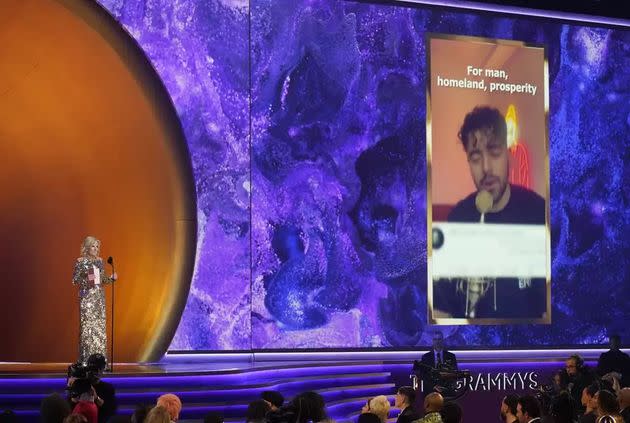
     On February 5, 2023, Shervin's anthem for the "Woman, life, freedom" uprising won a Grammy Award for best song in a "social change category., presented by First Lady, Jill Biden. A few months after receiving the award, He was sentenced to three years and eight months in prison for "spreading propaganda against the Iranian regime, and inciting unrest against national security. In addition to the sentence, Hajipour has been ordered to write an anti-US song as punishment for his very popular award-winning anthem that took the world by storm.  Shervin must craft his song about the atrocities committed by the U.S. It is blatantly obvious that this evil regime is seriously jealous of the overwhelming support that his anthem protest song received across the globe. By writing his song, Shervin Hajipour has "put a face" on every suffering Iranian, becoming a powerful voice for their human rights, something that is absolutely forbidden by this dictatorship government!


Saturday, June 22, 2024

Iranian rapper, Toomaj Salehi escapes the death penalty

 "Iranians are living somewhere horrific. You are dealing with a mafia that is prepared to kill an entire nation in order to keep its power, money, and weapons."


     Thirty-three-year-old, Iranian rapper, Toomaj Salehi, can breathe a sigh of relief. Iran's supreme court has overturned the death sentence, imposed on him back in April, after being charged with "corruption on earth," assistance in sedition, propaganda against the state, and calling for riots. Back in November of 2023, Toomaj had been temporarily released on bail but then was re-arrested two weeks later after producing a video describing his torture in prison.

     Toomaj's fiery lyrics have put him constantly on the "radar screen" of the Iranian government. He is unafraid to speak out and confront the corruption of the Islamic regime. His 2021 breakout hit, "Rat hole," gets in the face of the government, "Forced officer, forced executioner, one who just follows orders, go find a rat hole."


     Toomaj gained his celebrity status and worldwide following by speaking out and supporting the people of Iran during the violent 2022 "Woman, life, freedom" uprising, after the unjust death of 22-year-old Mahsa Amini, who was murdered in custody after being arrested on a Hijab violation, accused of showing too much hair. While in solitary confinement, Toomaj was brutally tortured by regime forces, who repeatedly hit him with electric batons and fists in the head, causing him to lose consciousness for 20 days. They also jumped on his stomach and ribs with their boots, breaking his fingers, ribs, and legs.

    My dear friend, Heather Joy, co-author of my book, "Uprising" We Are the Revolution," describes Toomaj in her article as a "truth teller, a voice that cannot be silenced." Heather believes, like I do, that Toomaj has a prophetic calling on his life, a strong leader with a compassionate heart. She describes him as a trailblazer forging a new path towards freedom for the people of Iran with his "in your face" rap lyrics!

    Heather and I meet every Sunday evening and spend up to two hours in prayer for the oppressed people in Iran. We had been storming the heavens in intercessory prayer that God would intervene and cancel his death sentence. This morning, we were overjoyed to discover that our faithful God had answered our prayers. Prior to news of Toomaj's death penalty being overturned, Canadian human rights activist, Nazanin Afshin-Jam, had been successful in persuading the House of Commons to sanction 31 regime officials in the judicial system, that were implicated directly in sentencing Toomaj. The international outrage and rallies in several cities, combined with artists like Sting and Coldplay, calling on the government to stop Toomaj's execution, have all played a significant role in putting pressure on the Islamic Republic of Iran.

     As vitally important as all of the activism behind the scenes is, Heather and I know without a doubt, how the incredible power of prayer has shifted this desperate situation. The Bible declares in James 5:16, that "the earnest prayer of a righteous person has great power and produces wonderful results," (NLT) What an encouraging promise from the Word of God that should motivate every Christian to engage in prayer regularly! The Bible portrays God as being sovereign over all of the evil actions and acts of sinful man. Daniel 2:20 (NLT) says, "He controls the course of world events."


     God is not finished with Toomaj. He has a plan for his life. He stepped in as the sovereign Lord of the universe and canceled his death sentence. While it's true, that Toomaj is certainly not out of the woods, yet one thing is for certain. The government tried but could not silence this truthteller's powerful voice!

Friday, March 8, 2024

"In defense of her honor."

 Writing the tragic story of Reyhaneh Jabbari was an incredible honor for me to scream loudly to the world about the horrific injustice that was done to this beautiful Iranian woman!


“I, Reyhaneh Jabbari, am 26 years old. With a hanging rope in front of my eyes, that I am not afraid of, I write to tell the tale that I lived...

I want to tell you everything that I said in court, which they did not understand, and everything that I cried out under torture, which was not heard. Everything that I screamed out while I was brutally kicked by four forceful interrogators, who regarded themselves as “Almighty.”

“Perhaps someone in this world would hear my cries and feel my pain…”


Reyhaneh Jabbari

(Prison letter #1)


Reyhaneh on trial, December 2008.


     In the Persian language, names have specific meanings that relate to life. The name, “Reyhaneh,” means, “flower, fragrance.” Ironically, my name, in the English language, “Randy” means, “defender.”

     I don’t believe that it’s a coincidence that I am writing this blog for Reyhaneh. I am not merely writing out of sympathy. It is much bigger than that! I believe I have the “God-ordained” task to live up to the meaning of my name. I want to be a “defender,” a defender of Reyhaneh’s honor as a woman. Reyhaneh was the helpless victim of a man’s uncontrollable sexual advances and she did what any honorable woman would do by defending herself.

     In Iran, the unfortunate reality is that women are the property of men, in a society that elevates the status of a man because of the Sharia Law. According to the Quran, Men are superior to women and the testimony of a woman is only worth half that of a man’s” (Surah 2:282, Surah 4:34)

     Reyhaneh grew up in this kind of culture and because she defended her honor against a former intelligence agent, her fate was sealed. The Iranian Regime would do everything in its power to protect the reputation of a government man, which meant that Reyhaneh had no hope of surviving, but instead would be sacrificed on the altar of convenience so that the Sarbandi name would not be tainted.

     Right before her execution, the Regime brought in cameramen and reporters to pressure Reyhaneh into changing her story.

     “Just say he did not try to rape me!”

     In the midst of great pressure to preserve her life, Reyhaneh refused to lie and compromise the truth, but instead she stood strong and tall as a majestic mountain and looked in the face of her accusers and responded, “ I will not lie!”

     The reason I chose the name, “a beautiful fragrance” as the subtitle of my book is because Reyhaneh exemplified and lived up to the meaning behind her name. She was a beautiful fragrance of honor, kindness, mercy, and courage. She forgave her interrogators shortly before her execution and showed kindness and compassion to the many women political prisoners who came from destitute and filthy walks of life.

     This blog is about a remarkable, extraordinary and inspiring woman who suffered greatly at the hands of an evil dictatorship and illuminated a dirty prison with the beautiful fragrances of her wonderful character.

     It is my honor and pleasure to be a voice for her honor!