Total Pageviews

Sunday, November 5, 2023

"Hasti Panahi, Awaken!"


"Open your mouth with a mighty decree, I will fulfill it NOW, you'll see. The words that you speak, so shall it be!"

                               (Psalm 81:10, The Passion Translation)


      Every Sunday evening, I meet with my Christian friend, Heather on the internet and we spend up to two hours praying for the oppressed people in Iran, especially women, who are specifically targeted by the Morality Police for refusing to wear their hijab. Since September of 2022, we had been very busy praying and being a voice for Iranian women, after the unjust murder of 22 year-0ld Mahsa Amini, who was beaten while in custody for wearing an improper hijab. Her death sparked the #Woman,life,freedom uprising in Iran, which by January of 2023 had already claimed the lives of over 700 peaceful protesters and the arrest and torture of thousands of others.

     During one of our prayer sessions in January of 2023, I distinctly remembered sharing with Heather, the tragic story of a young Iranian school girl, who had been severely beaten in the head by security forces while at school. 16 year-old, Hasti Hossein Panahi, was confronted by the school principal and shown a video of her taking part in an anti-government protest rally and ripping up a picture of the Supreme Leader. A few minutes later, Hasti and her classmates were taken away from the school to an undisclosed location and reportedly beaten by security forces. Hasti suffered severe brain trauma and lapsed into a coma. The doctors told her family that she had very little chance of recovery. It was at the same time in January that hundreds of young school girls had been rushed to the hospital suffering from some unusual type of toxic poisoning. It was suspected that the government was behind their deliberate poisonings, since videos of the schoolgirls protesting against the Supreme Leader, had been uploaded to the internet and now The Islamic Republic of Iran was exacting revenge on them!

     As Heather and I began praying, I cried out to God to heal Hasti and miraculously awaken her out of her coma!


    The powerful promise of Psalm 81:10 echoed in my mind during my prayer time and I clearly remember declaring, "Awaken Hasti, awaken! I speak life unto you. Awaken from your coma!" God promises us in Psalm 81:10 to "Open your mouth with a mighty decree, I will fulfill it now, you'll see. The Words that you speak, so shall it be." 

     The powerful promise of Psalm 81:10 gave me incredible boldness to decree Hasti's healing and confidently expect that she would awaken from her life-threatening comatose condition.

     Months passed by and there were no updates about Hasti's condition. Heather and I continued to meet and pray for her recovery. In March of that same year, I published my newest book, entitled, "Uprising: We are the Revolution," that told the tragic stories of  young Iranian women who had been killed by the government for peacefully protesting in the streets. Being a voice for the oppressed women of Iran is the passion of my life and I wanted to educate readers about their daily struggles for freedom under a dictatorship government.

    The last news item that I had read about Hasti's condition was that the doctors sadly informed her family that she was brain dead and had no hope of recovery. But doctors don't have the final word! When doctors say there is no hope, that's when Jesus steps in and declares, "I am writing your story, dear Hasti. I will have the final say. I am writing the next chapter of your life and no demonic force in hell can stop your miracle!"

     Three months after our passionate prayer for Hasti's recovery, Jesus miraculously awakened Hasti from her coma! You cannot begin to imagine the absolute joy that Heather and I experienced when we read the incredible news! Hasti emerged from her coma after six months and was released from the hospital in a wheelchair. She is unable to move her arms and legs because of the severe brain injury, but Heather and I know that God is not finished with Hasti's miracle. We are overwhelmed with joy at what God has done in response to our decree, one January night, when we cried out in prayer, "Hasti awaken!" God didn't revive Hasti from a life-threatening coma to leave her confined to a wheelchair for the rest of her life. We are praying and fully expecting our great God to finish writing Hasti's miraculous story, by raising her up out of her wheelchair so that she can finish school. Our prayer now is that God will open a door for Hasti and her family to escape from Iran and find a host country with a doctor that will treat her for her paralysis. No 16 year-old girl should have to live under such oppressive conditions with the fear of being beaten for not wearing a hijab when she goes out publicly. The young women of Iran are now under video surveillance by the government and small business owners will be shut down if they allow them to inside without wearing a proper hijab.

     I regularly use Psalm 72 when praying for my dear Iranian friends. Psalm 72 is a powerful promise that God will rescue the oppressed when they cry out to him. Verse 12 declares that "He will redeem them from oppression and violence, for their lives are precious to him," (New Living Translation.)

     Hasti's life is precious to our compassionate God. He has not finished writing her story. He has a plan and purpose for her life and very soon, Heather and I expect that we will hear the amazing news that she can finally walk again!

Sunday, May 21, 2023

Toomaj Salehi: Truth teller, a voice that cannot be silenced.


Heather Joy, my co-author from our book, "Uprising: We are the revolution," writes a powerful plea to be a voice for imprisoned Iranian rapper, Toomaj Salehi.


Toomaj Salehi

Truth-teller: a voice that cannot be silenced.

“If you’re not in the fight {for freedom} with us, then don’t bother

fighting for my release.”

Heather Joy


     Toomaj woke up at the sound of his alarm. It was 8am in the beautiful city of Isfahan. Toomaj pulled back the covers, went to his closet, and picked out his outfit for the day. Then, he walked to the bathroom where he brushed his teeth and took a shower. Fifteen minutes later, he put on his clothes and walked to the dining room. He pulled out one of the chairs from the dining room table and put on his favorite pair of sneakers. Toomaj grabbed his keys and wallet before heading out to his day job where he worked as a welder at a metal factory. Although Toomaj was a top-notch employee and enjoyed the company of his fellow co-workers, his truest passion is music. His rap lyrics speak of the injustice and oppression that Iranians have suffered under such a corrupt and notoriously wicked regime.


     In addition to his musical career, Toomaj has maintained a strong social media presence. When you listen to his words, he makes you think about things from a different perspective. It is not surprising that Toomaj has a large following and thousands continue to be inspired by him. He is a strong leader and has a compassionate heart. I personally believe, deep in my heart, that Toomaj has a prophetic calling upon his life. He has yet to discover it but in due time, he shall step into it. On his personal accounts, he sought to bring encouragement to his fellow Iranians. He would stress the importance of unity and caring for one another. One day, I randomly stumbled upon one of his videos, and in it, Toomaj proclaimed that “this country is ours; it belongs to the people.” I decreed these exact words!!! What a prophetic confirmation to the things that the Lord has spoken to me, concerning Iran and her precious people! The land of Iran has been prophetically claimed for good things! Like Toomaj, many Iranians are trailblazers, who are forging a new path towards freedom.  Behind the scenes, I believe that the Living God is creating a new future for the Iranian people that is more glorious than what is seen in this current season of turmoil.


      As a prominent figure with a significant platform, media outlets would request interviews with him and Toomaj would often discuss the plight of his nation, the barbarity that Iranians have suffered and continue to endure, and ways in which people {or other nations} can stand in solidarity and press {with international pressure} for regime change. In one of his interviews with a Canadian news outlet, when asked about his thoughts regarding the regime, Toomaj boldly stated, “We are dealing with a mafia that is willing to kill the entire nation to keep their power, money, and guns.” Yet the regime has continued to fail in their efforts to silence Toomaj. Stretching all the way back to 2021, he would have encounters with security forces who wanted to confront him on the basis of his rap lyrics.


     The following year, they subsequently arrested him on January 12, 2022, charging him with “activities of propaganda, and inciting the Supreme Leader.” Toomaj’s sentence would be deferred for 6 months and he would be released on bail as his supporters condemned his arrest. During that six-month period, Toomaj was summoned to court but he skipped his court date to write another song entitled, “Tanabe Daar” {Gallows Noose} Toomaj continued to create more song lyrics and conduct more interviews until he was arrested on September 12, 2022. The IRGC traveled to the province of Chaharmahal {in Isfahan} and barged into Toomaj’s home, placing handcuffs on his wrists and shoving him outside to one of their vans. He faced the same charges but they would not stand. Nine days later, on September 21, 2022, the outcry of his supporters combined with increased international pressure led to his release, though it would be short-lived. After the unjust murder of Mahsa Amini, Toomaj joined his fellow countrymen in the streets. Between his rap lyrics, and joining the protests, the IRGC tried to paint Toomaj as a terrorist, saying “he’s a leader of the riots, and he incites violence.” I posit that the regime is fearful of truth-tellers like Toomaj. He is a leader but not in the way that he has been painted. Just a month later, Toomaj was re-arrested on October 30, 2022. They blind-folded him, placed handcuffs on his wrists, and shoved him back into one of their vans.  The state media claimed that Toomaj was fleeing the country in order to tarnish his reputation even further and paint him as not only a terrorist but a coward.


     Toomaj is no coward; he would not abandon his fellow Iranians as they continue to fight for freedom. After all, freedom is not a crime!


      On November 26, 2022, after he had been sitting in a prison cell for some time, the Revolutionary Court held Toomaj’s trial behind closed doors where he would face a different set of charges. His lawyer was barred from seeing him or providing any sort of legal defense. Instead, Toomaj was charged with “Moharebeh” {enemy of God} and corruption upon the earth. He is in imminent danger of being executed. As of this writing, his family has not heard from or spoken to Toomaj since his latest arrest. He is currently being held in Dastgard Prison where he has undergone severe physical and psychological torture. It has been over 100 days since Toomaj was placed in solitary confinement and he has wavered in and out of consciousness since the start of his sentence. His body has been wracked with pain. At this point in time, they have broken his ribs, making each breath nearly unbearable. They have broken one of his legs, leaving him unable to walk. Other injuries include a broken nose and fingers. Toomaj has also lost his eyesight in one eye. He has gone on a hunger strike to protest the unjust and downright cruel ways in which the regime continues to treat political prisoners.


     Security forces have denied Toomaj from receiving any level of medical care, of which he is in urgent need. They are doing everything they can to break his spirit but he continues to be strong in the face of it all. To fight for his life and not back down from speaking the truth, it must be noted that psychological torture is no joke. Though he is a freedom fighter and has a strong will to survive each hardship that is thrust upon him, he is also a human being. Toomaj is struggling with the battle going on in his mind. The mental scars he carries will require much healing. Toomaj knew the risks but he has always stood his ground. He exemplifies courage and truth is important to him. Do not believe any false confessions that the regime would seek to extract from him and use as another means to promote fear. I do not believe that he would compromise the truth. In this age and hour, every evil thing will be exposed and brought to the light. For close to four decades, the regime has set themselves up as “God.” However, in the {ongoing} fight for freedom, the people's courage and their bravery speaks more powerfully.


      Join in this fight for freedom, for freedom is worth fighting for. Be Toomaj’s voice, as he has been a voice for the voiceless and has inspired positive change all over the world.  As for this regime, they are being exposed for everything that they are and for everything that they stand for. Their time will soon come to an end!

Sunday, April 16, 2023

"A history of the Hijab Law in Iran."


An excerpt from my book, "Uprising: We are the revolution."


     “What you’re seeing today is not something that just happened. There’s been a long history of women protesting and defying authority in Iran.”


     The brutal and unjust murder of Jina Mahsa Amini by the morality police has a long history behind it. In order to understand and put into context the oppressive treatment of women by the present Iranian government, it is necessary to take a brief historical survey of the evolution of the Hijab Law in Iran.

     Tihara Qurrat al- ‘Ayn was one of the first women to unveil, questioning the political and religious orthodoxy in Iran. Tihara was a poet and religious scholar for the Bahai faith. She was very outspoken against the restraints placed on women and during a Babi conference in 1848, she unveiled before a congregation of men during a lecture. Her opposition to the treatment of women and her involvement within the Bahai faith, landed her in prison in 1852.

     “You can kill me as you like, but you cannot stop the emancipation of women,” Tahira proclaimed, realizing her death was imminent.

     In August of that same year, Tahira was the first woman to be executed on the grounds of “corruption on earth.” She was strangled to death by her own veil, thrown in to a shallow well, and stoned to death at the age of 35.


********************


     The first real challenge to the conservative religious establishment in Iran came by Reza Shah, General of the Persian Cossack Brigade, and recognized as the first Shah of the House of Pahlavi. He introduced social, economic, and political reforms, replacing Islamic Law with modern Western laws. It was under his reign that Iran became a constitutional monarchy. Striking out against the establishment, Reza Shah banned Islamic clothing, separation of the sexes, and the mandatory veiling of women. In 1936, he implemented “Kashf-e-hijab,” a reform that was aimed at weakening the conservative/traditional religious system. The law stated that if a women wore a veil in public, the police had the right to remove it. The Shah regarded the hijab as a sign of “backwardness” and went so far as compelling men to wear western costumes and hats. The religious establishment was outraged at the new reforms and declared that the unveiling of women was a mortal blow to their values and power.

     In 1941, when Reza Shah went into exile, the ban eased, allowing women to return to their traditional ways of dressing.

     The Shah’s son, Mohammed Reza Shah Pahlavi was also greatly influenced by western culture. In 1963, he introduced a series of reforms, called, “The White Revolution.” One of the laws implemented gave women the right to vote. Four years later in 1967, women were finally granted equal rights in a male-dominated society. The age for marriage was raised from 13 to 18 years of age. This also angered the religious establishment. The Ayatollah Khomeini, who had been exiled by the Shah, began preaching the concept of an “Islamic republic,” through books and cassette tapes. His sermons and teachings began to take root in the conservative/religious establishment, causing uprisings, and demonstrations by thousands of people. Unable to cope with the growing protests, and death threats, like his father before him, the Shah and his family were forced into exile in January 1979. This immediately opened the way for the Ayatollah Khomeini to return from exile in Paris and on February 1, he was greeted by millions of supporters in Tehran to begin the Iranian revolution.

     The Ayatollah immediately reversed all of the reform policies of the Pahlavi Dynasty. Beaches and sports became “sex-segregated.” Women were no longer allowed to serve as judges and the Islamic Clothing Law was re-instituted.

    On March 8, 1979, International Women’s Day, tens of thousands of women marched into Tehran, protesting the veil law. Three thousand women gathered in Qom, the religious city and residence of Khomeini. The women boldly marched into the city without wearing their veils, chanting, “We didn’t’ have a revolution to go backwards.”  There were also 15,000 protesters who gathered at the Palace of Justice for a three-hour sit in, presenting a list of demands, including the right of choice to dress, equal civil rights with men, and no discrimination in the political, social, and economic arenas. However, the new Ayatollah refused to listen!

    In July of 1981, The Hijab law was passed and veiling in public became mandatory. Two years later, The Islamic punishment law was instituted stating that if a woman was caught unveiled in public, she would be sentenced to 74 lashes. Every reform of freedom that had been instituted by the previous Shah, had been completely abolished by the Ayatollah Khomeini. The oppression of women had begun, and they would be ruled by Islamic law from the cradle to the grave.

     Under the presidency of Ahmadinejad in 2005, the Morality Police was established, which would begin patrolling the streets searching for offenders of the Hijab Law.  The Iranian government recently has upgraded their efforts to prosecute women violators by implementing new technology using facial recognition. Now women are receiving citations in the mail for hijab violations even though they have not had any physical contact with law enforcement. Iran’s national identity database, which was built in 2015 by the Cyber Police, contains facial scans for national ID cards. This database is being used to identify and catch veil law breakers as they travel to shopping malls and peruse the streets of Tehran.

    In August of 2022, President Ebrahim Raisi introduced additional hijab and chastity restrictions. Women who violated the law can now lose access to banks, public transportation, and other essential government services. Repeat offenders can spend years in prison for refusing to veil publicly. This new technology is a policy shift that relies less and less on informants and physical contact with Morality Police. Digital surveillance had become the new tactic to keep track of “veil violators.” The government is using their new technology to enforce their gender apartheid. In 2020, women began receiving text messages in their car, reminding them to wear a veil or be arrested. The facial recognition technology reduces the presence of police, especially cutting down on the brutal clashes between citizens, as in the case of Mahsa Amini. Facial recognition technology comes directly from the Chinese camera and artificial intelligence company, known as Tandy, Tandy is one of the largest security camera manufacturers in the world.

     For over 43 years, the women of Iran have suffered greatly under a government dedicated to oppressing their human rights. From the ban on attending sports events to riding bicycles, women have reached their limit. They are rising from the ashes of discrimination. This is now their revolution!


Tuesday, January 24, 2023

"Hadis Najafi: Preparing for battle."


An excerpt from my upcoming book, "Uprising: We are the revolution."


                                                               Hadis Najafi

                                                         “Preparing for battle”
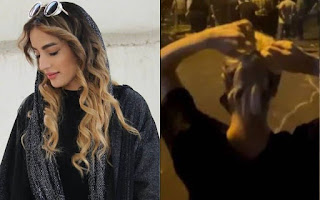


     Hadis Najafi ended her shift at the Takata Fast Food Restaurant at 5 pm and clocked out. It had been a very busy afternoon as the lead cashier in one of the most popular cafes in the city of Karaj. The city of Karaj lay nestled up against the majestic foothills of the Alborz mountain range, a distance of just six miles from the capital city of Tehran. Karaj city was a haven for young students studying art and medical science at Azad University. For Hadis, being a student was not her passion in life. Instead she was a dedicated “social media geek.” She loved to display the latest fashions on her Instagram account and treat her fans to Persian dancing on Tik Tok. Politics and religion didn’t interest her. She spent her money investing in VPN, to overcome the filtering of the internet, so she could talk to her friends online every night. The Islamic Republic of Iran along with the help of the cyber police had blocked the major social media platforms, Facebook, Twitter, Telegram, You tube, etc. The only way to overcome the government censorship was to purchase the virtual private network app.

     As Hadis left the restaurant and stepped out onto the sidewalk, she looked carefully in both directions, to see if she could spot the Morality Police Van and then ripped off her hijab and threw it down on the ground.

     “I hate that damn thing!” Hadis muttered to herself.

     This evening, Hadis was not her cheerful self. She was not in a good mood. The tragic death of Mahsa Amini had tormented her mind all day. Dealing with impatient customers paying for their meals and complaining about the prices had pushed her to the limit. She wasn’t in the mood to listen to them, especially when a young Kurdish girl had been beaten to death by the Morality Police. Hadis had never been outspoken or political, but tonight was different. Every time she gazed at the picture of Jina Mahsa on her cell phone, lying comatose in a hospital bed, she couldn’t hold back the tears. Deep down in her soul, she felt an irresistible urgency to see justice for Jina. Hadis felt it was her duty to humanity to be Jina’s voice and scream loudly at the government ‘s unjust murder of an innocent young woman.

     Hadis arrived at the bus stop and broke away from the crowd of people for a few moments. She quickly speed-dialed her friend Farzad.

     “Dorood, Farzad (Faris for hi) Chetori?” (Farsi for, “How are you?”)

     “I’m good. You just get off work, Hadis?”

     “Yes. I’m on my way home. Listen, I wanted to tell you. I am going to join the protest tonight. I heard they will be out on Eram Boulevard.”

      ”Hadis, are you crazy? You’ve never been political.”

     “I know. I know,” Hadis replied, stepping onto the arriving bus, “But I have to do this for Jina. I believe we must be her voice. Women have got to rise up and let this damn government know that we will not be oppressed anymore. We have the right to wear what we want to wear!”

    “Please be careful, dear friend,” Farzad cautioned Hadis.

     Hadis clicked off her cell phone and relaxed back in her seat, taking a deep breath. Tonight, was Wednesday, September 21. Wednesday was her usual night for doing live Persian dancing for her fans on Tik Tok, but that would have to be postponed. She would celebrate with her fans later, but tonight was reserved exclusively for Jina. “Justice for Jina” was weighing heavily on Hadis’s mind and nothing was going to stop her!


                                                                      *****************


     Hadis walked through the front door of her home, exhausted, but energized to go back out. She decided to change her clothes and grab a quick bite to eat before joining the protest.  As soon as she entered the kitchen, her mother noticed her flowing blonde hair draping down over her shoulders and a frustrated look in her brown eyes.

     “Where is your hijab, Hadis? Didn’t you wear it today?  You must be so careful now these days.”

     Hadis flopped down in a chair at the kitchen table and grabbed an apple to eat.

     “I threw that damn thing away. I hate it!’ Hadis answered back while munching on her apple.

     Mrs. Najafi sat down at the table across from Hadis with a worried look on her face.

     “Hadis! Don’t say that! You worry me! Look what happened to that Kurdish girl just last week!”

      Hadis sat down the apple in front of her and stared back intently at her mother.

     “That’s why I threw my hijab away, mom. I did it for Jina. I did it for every Iranian girl. We are tired of being oppressed and told what to do!” Hadis shouted back, banging her fist on the table.

    Mrs. Najafi sat quietly and took a nervous deep breath. There was no arguing with her daughter. She was much too free-spirited and independent. Hadis quickly stood up from the table and dabbed her lips with a napkin.

     “I must go out tonight, dear mother. There is going to be a protest on Eram Boulevard. I need to go for Jina.”

    Mrs. Najafi rubbed her hand across her forehead and bowed her head in fear for a few moments. Then she stood up and hugged Hadis.

    “I understand Hadis. But I am so worried. I am so afraid. It is so dangerous.”

     Hadis gave her mother a reassuring look and kissed her softly on the forehead.

     “I must do this, mom. I will be careful. I promise I won’t stay out very long.”

     Hadis left the kitchen and hurried into her bedroom. She quickly changed into a pink tank top and put on a fresh pair of blue jeans. She flopped across her bed and turned on her cell phone. The first picture that appeared was that of Jina Mahsa Amini, sitting in her living room last year, in front of a chocolate cake, celebrating her 22nd birthday. Hadis smiled. It was one of the happier moments for Jina. Hadis was also 22 years old, just like her hero, who was cruelly murdered just a week before her 23rd birthday. Tears filled her eyes. She blew a kiss toward the picture on her cell phone screen.

     “Tonight, I will be your voice, dear Jina and I won’t stop shouting until you get justice!”


                                                                     ***************


     “Death to the dictator! Woman, life freedom!”

      The angry loud shouts of protesters filled the cool night air on Eram Boulevard.  It was just a few minutes before 8 pm as Hadis turned on her cell phone. She aimed the camera toward the protesters filling the streets. Just up ahead she noticed a bonfire in the center of the street and watched several women setting their headscarves on fire. Running swiftly toward the scene, Hadis began narrating the live video she was creating for her friends.

    “This is a scene of women burning their hijabs,” Hadis shouted out loud in laughter. “You go girls!”

     In the distance she heard sirens and more angry shouts of protesters chanting. Tonight, she felt energized and unafraid. She had never been to a protest before. Hadis remembered back to 2019 when more than 1500 peaceful protesters were gunned down in the streets. At that time, she vowed to never be political and just mind her own business. But all of that suddenly changed with the death of Jina. Tonight was personal. Tonight, she had to make a stand for the women of Iran. She regretted for being so selfish and passive a few years ago, but that had all changed.

    Passing a local hardware store, Hadis paused, catching her breath and spoke directly into her cellphone continuing to film the protest.

     “I hope in a few years, when I look back, I will be happy everything has changed for the better. I like to think that when I think back about this a few years later, I’ll be pleased that I joined the protest.”

     A few women, following close behind her, began chanting, “Woman, life, freedom.” They were carrying signs with a picture of JIna Mahsa Amini. At the bottom of the sign, it read, “We are all Mahsa.” Hadis was excited to see that that two young men were in the crowd of women chanting along with them. It was so encouraging for her to see men involved in the uprising and defending the rights of women.

     Suddenly, the sounds of security forces yelling for protesters to halt or they would shoot, startled Hadis. Beads of sweat began rolling down her face. She took an angry deep breath and vowed once again to not be afraid. Putting her cell phone in her pants pocket, Hadis stood still for a moment. She tied back her blonde hair into a ponytail and twisted a rubber band around it to hold it into place. An exhilarating feeling of courage surged through her body. Tying back her hair was like preparing for battle. Tonight, Hadis was making a bold statement to the government that she refused to comply with the man-centered Hijab Law. This was her hair, her body, and no man had the right to control it or tell her what to do.

   The security forces began clashing with the protesters and beating some in the heads with their batons. Instead of cowering in fear, Hadis closed her eyes and in her mind’s eye, she remembered back to her favorite movie, “Braveheart.” She could see the chilling scene, where William Wallace was laying across a torture rack and the King pleading with him to recant and beg for mercy. She smiled, remembering the famous last shout from William Wallace’s lips, when he screamed, “Freedom!”


     The first shot terrified Hadis! She clutched her abdomen in excruciating pain. A barrage of shots immediately followed the first one, sending frightened protesters scrambling for cover. Hadis collapsed backwards on the hard pavement, struck by five more bullets in the neck, chest, and face. The beautiful blonde freedom fighter lay dead on the street in a massive pool of blood. She had made her courageous last stand on Eram Boulevard in the city of Karaj, unafraid and unashamed to die as a martyr for freedom in the never-ending struggle against the gender apartheid in Iran.


                                                                   *****************


     A few days after her tragic death, a video surfaced showing a young woman tying back her blonde hair and preparing to join the protest in Karaj. The video was attributed to Hadis, just seconds before she was fatally shot. Although there is some controversy concerning the video being actually that of Hadis, nevertheless, it had been unanimously attributed to her as showing the final seconds of her life.

    Security forces refused to hand over Hadis’s body to her family at the hospital until they signed a pledge stating that she died of natural causes. Devastated over her tragic death, a family member, who was a member of the Basij (Iranian paramilitary) was finally granted permission to make a formal identification of the body. He verified that it was indeed Hadis and was horrified upon examination, that she suffered at least 20 gunshot wounds in her body at very close range.

    Mrs. Najafi, even though being warned by security not to speak publicly about her daughter’s death, declared, “My daughter was murdered for hijab, for Mahsa Amini. She wanted to keep Masha’s name alive. Mahsa is also my daughter and all those killed are my children. She died for Mahsa. She sacrificed herself for Mahsa.”

   Shortly after her death, Hadis’s sisters, Afsoon and Shirin, published her photos and told people that she was shot, defying the government ban.


                                                                  *****************


                                                                      Reflection


     Hadis Najafi, bravely took to the streets, understanding the great risk, and proudly declared her right as a woman, to display her beauty, rejecting the mandatory Hijab Law. She died for the right to choose, the freedom to say no to a dictatorship government. In the last seconds of her life, she spoke up for Mahsa Amini and all Iranian woman, when she tied back her hair and faced the firing squad.

    Jesus proclaimed in John 10:10:

     “The thief does not come except to steal, and to kill, and to destroy. I have come that they may have life, and that they may have it more abundantly.”

    For more than 40 years, The Iranian people, especially women, have suffered greatly at the hands of a corrupt and controlling government. They have had their dignity stolen, their freedom suppressed, and their lives destroyed by satanic forces. Jesus, as the good shepherd, who desires to gently lead and guide us, declares that the thief of our souls, Satan, has as his core mission to kill and destroy us. In contrast, Jesus promises to protect and provide for his people. His mission is to bring us life and life to the fullest. He came to bring you true hope and freedom. He promises to remove the shackles of your oppression and give you a life filled with meaning and purpose.

Sunday, October 2, 2022

"Randy. Please be our voice. They're killing us!"


         I was relaxing in the break room at Chick Fil A just a few minutes before the beginning of my shift, when I received a voice message on Telegram. I noticed it was from my Iranian friend, Mahdis whom I hadn't heard from in a very long time. I immediately opened it up to listen to the message and was completely unprepared for what I was about to hear. In a trembling voice racked with tears and desperation, Mahdis pleaded with me from the other side of the world:


   "Randy. Please be our voice. They're killing us! They're killing both young and old. Please be our voice!"


     Chills ran up and down my spine. Tears filled my eyes. I was gripped by an intense feeling of urgency. I banged my fist down on the table in frustration. The lives of my Iranian friends were in danger and I wanted to be there right now to stand by their side and fight with them! For the last ten days, brave young women joined by men, in more than 110 cities across Iran, had taken to the streets, outraged over the senseless and brutal death of Mahsa Amini. The Morality Police had arrested her on September 13 for not wearing her hijab properly and showing too much hair. They explained to her brother that she was being transported to a detention center in Tehran to be re-educated on the Islamic dress code. A few hours later she was pronounced "brain dead" at a hospital, lapsing into a coma. The official explanation was that Mahsa had suffered a heart attack, but bystanders had witnessed her being beaten in the head as she was being forced into a police van.


     The cruel and unjust death of Mahsa Amini had sparked a revolution with thousands of Iranian men and women taking to the streets outraged and demanding freedom from a dictatorship government. I had been very busy on my Facebook page, posting stories and videos in support for my dear Iranian friends. I had also reported on their plight and struggles for freedom on my blog talk radio program, "The Cross in the Desert." I immediately sent back a voice message assuring Mahdis that I would be her voice and the voice of all Iranians. I pleaded with her to be careful and told her that I would be praying for her safety.

     "Randy, please be our voice."


     I cannot adequately express into words, the awesome responsibility of being their voice. It is the passion and the driving force of my everyday life. It is the reason that I write their stories in my self-published books. I will never forget the incredible story that Mahdis shared with me a few years earlier right before the Persian New Year in Iran. She recalled a frightening incident one day at school when she was just a little girl. The teacher had sternly warned all the girls in the class that they had better wear their hijabs according to Islamic law or if not, that on judgment day, "Allah would dangle them over the fires of hell by their hair!"


     Growing up in Iran, as a child, this was the picture of God that Mahdis had been taught. God was not a god of mercy or love, but rather a god of fear and retribution that could not wait to punish his disobedient children. You could hear in her trembling voice, that same little girl, now terrified and pleading with me to support them. 


     I bowed my head in prayer for Mahdis and remembered the awful story that I had read the day before about the tragic death of another young Iranian girl. Sixteen-year-old, Nika Shakarami, had bravely joined the protest in the streets and never returned home. Ten days later, her parents were told to come and see her lifeless body in the morgue. Nika's nose had been smashed in and her skull crushed. A few days earlier, twenty-two-year old Hadis Najafi is seen on a video tying back her blonde hair in protest and marching down the streets of Karaj only to be shot six times and killed for the crime of wanting freedom. As I remembered these horrifying stories, I was gripped with the fear of that same tragedy happening to my dear friend Mahdis. 

I could not bear the thought of that tragedy for another second, so I reluctantly got up from the chair to begin my job.


     There is nothing more important to me in my life than being a voice for my Iranian friends. I'm not doing this for money, fame, or popularity. I do it because I love them.  I do it because the Bible admonishes me to be their voice for freedom.


     "Open your mouth for the mute, for the rights of all who are unfortunate and defenseless. Open your mouth, judge righteously and administer justice for the afflicted and needy."


(Proverbs 31:8-9)


     Being silent in the face of injustice, cruelty, and the slaughter of human life, is an egregious sin that lacks any sense of humanity or compassion. It was the great German pastor, Dietrich Bonhoeffer, who courageously defended the church during World War II and was unafraid to stand up against Hitler. He rebuked the weak and afraid, proclaiming,


     "Silence in the face of evil is itself evil: God will not hold us guiltless. Not to speak is to speak. Not to act is to act."


     If Bonhoeffer were still alive today, I believe he would raise an accusing voice toward the mainstream media for their silence and ignorance when it comes to the human rights of the Iranian people. They are willingly silent in the face of evil! We need a prophetic voice that will be unafraid to confront the evil of silence and to confront the self-centered governments of this world who have economic ties with the Islamic Republic of Iran, lining their pockets with profits while ignoring their desperate cries. The Biden Administration is a prime example of sinful appeasement for the sake of a legacy.


    They are willing to sit down at the table across from this terrorist regime and renegotiate a nuclear deal instead of rebuking them for their oppressive policies against innocent people, and speaking up for human rights.  President Biden wants to have a legacy behind his name, like Barak Obama did in 2015, when he gave billions of dollars of sanction relief money to the Iranian government that was spent on furthering terrorism in the Middle East.


     I refuse to be silent in the face of evil. Right after work, I messaged Mahdis back on Telegram, promising her that I will never back down and never give up until she can walk down the streets of Tehran one day without fear under a new government of freedom and democracy.


     I want you to hear the desperate voice of Mahdis with me! I want you to feel the fear, the panic, and frustration tearing at her soul. It is only when we together raise our voices and bring awareness and condemn the evil, that Iranians have any hope for a bright future, a new tomorrow, where the shackles and chains of a dictatorship are finally torn away from their hearts and minds.


     Speak up for those that cannot speak for themselves. It is our humanitarian duty. It is our calling.


Tuesday, September 28, 2021

"Submission doesn't mean that I'm your slave!"

 My latest blog is an excerpt from my book, "Broken yet beautiful: Rising up from their ashes."

Women are rising up and becoming bolder, speaking out against psychological and physical abuse that is running rampant in the church. This is completely unacceptable that the "Bride of Christ" should treat its women in such a horrific way. One of the hot button issues in the church is the doctrine of submission that has been twisted in an abusive way treating women like a doormat. I pray that this article will breathe life and bring freedom to oppressed women that in most cases remain silent and afraid


“Don’t get drunk with wine, which produces depravity. Instead be filled with the Spirit in the following ways:  Speak to each other with psalms, hymns, and spiritual songs; sing and make music to the Lord in your hearts; always give thanks to God the Father for everything in the name of our Lord Jesus Christ; and submit to each other out of respect for Christ.  For example, wives should submit to their husbands as if to the Lord. A husband is the head of his wife like Christ is the head of the church, that is the savior of the body. So, wives submit to their husbands in everything like the church submits to Christ. As for husbands, love your wife just like Christ loved the church and gave himself for her…….”

                                                                                                             (Ephesians 5:18-25 CEB version)


      Submission is a term that has been greatly misused by the church, resulting in control and abuse against women. It has been manipulated out of context to elevate one person over another, wrongly putting a woman in inferior subjugation to her husband. It’s very important from the very outset to give a Biblical definition to the word, submission.

      Submission does not mean obey! The Greek word for obey is hupakoe, (meaning, listen or hearken to.) In contrast, the Greek word for submission is hupotasso, (meaning, to get under, lift up, or put in order.)

      It is very enlightening to discover the German translation of the word submission, refers to the sharing of tasks, to support. A perfect way to sum up what Biblical submission means in context is, the Christian grace of voluntarily yielding one’s preferences to another.


          Paul points out in verse 21, “submit to each other out of respect for Christ.”


     This verse describes submission as volitional, submitting to each other in order to reflect the character of Christ. When Paul used this “hot button” word, submission, he was giving Christians a way of coping with a culture that was hostile to Christ. In the ancient world, women did not have an abundance of rights. They were not considered equal to men. When Paul commands husbands and wives to submit to each other, he was teaching a new and revolutionary concept. 

     This concept was contrary to the household codes of Paul’s day in both Rome and Greece. Wives in the ancient culture were little more than possessions of the husband. Slaves had no rights except what their masters gave to them. Therefore, when Paul commands, “husbands love your wives just like Christ loved the church and gave himself for her, (verse 25) he was giving a command that went competently contrary to the accepted norm of the day. In the ancient household codes, the husband acted as the Lord and had the final word in everything. For Paul to tell the husband to love his wife, was a revolutionary new idea! This was a patriarchal society and the concept of partners in a marriage voluntarily submitting to one another was shocking!


      When interpreting Paul from a true Biblical context, submission is not something the wife does to her husband in a subordinate position, but rather submission is embraced voluntarily, rather than forced. Submission is done out of love for Christ and each other. It is purely a relationship concept! Women are not to be treated like a doormat. It is not a matter of who is in charge! Submission is a metaphor for mutual love and devotion. The relationship between spouses is an “echo” of the relationship between Christ and the church. Therefore, submission is an act of sacrificial love between two partners!

       Ephesians Chapter 5 speaks of being filled with the spirit. If the marriage partners are both filled with spirit than they will be subject to each other and clothed in humility. There is a mutual respect for one another. True submission has nothing to do with the giving up of one’s rights. Referring back to the Greek word, hupotasso, submission in context means, “to support, uphold, cooperate, and giving in.”

       This meaning paints a beautiful picture of husbands and wives supporting one another in the spirit of love and unity. Christ is the real “spiritual head,” with whom all authority rests. Marriage has never been meant to be a power struggle with the idea of one person being in charge. Instead, the male and female are meant to exist in a covenant commitment to each other, in which the two become one through mutual love, support, and respect.

        At the heart of submission is the deliberate surrender of power. Our motives for such submission to one another is “out of reverence for Christ” (verse 21) The prime example of this is Jesus in the incarnation, when he voluntarily relinquished his power in becoming one of us and died in our place, (Phil. 2:5-8) We imitate him by letting go of power and exercising humility in our relationships.

        In the ancient patriarchal society, the image of the husband was one of being in control and in charge. Here in Ephesians Chapter 5, Paul challenges that false concept with the truth of God’s word. He elevates the wife and charges the husband to love her sacrificially. It was a radical new concept for that day. Unfortunately, the traditional understanding of submission being taught today is more reflective of the ancient culture rather than what the Bible teaches. 

     The church needs to return to the Biblical model of submission which is one of voluntarily yielding to one another in respect and devotion!


Tuesday, September 14, 2021

"The long slow death of Afghan women under Taliban rule."


For twenty years Afghan women have had a real taste of freedom. But now all of that has drastically changed! What will their fate now be once again under the oppressive rule of the Taliban?


   When the U.S. Military finally pulled out of Afghanistan on August 30, 2021, they not only abandoned billions of dollars worth of valuable equipment that became a gift for the enemy, but they also left behind thousands of American citizens, including Afghan women. For twenty years, Afghan women had enjoyed a new life of freedom where they could go to school, have regular jobs, vote in elections, and be a productive part of society without the stigma of being treated as second class citizens.


However on August 31, 2021, "all of that drastically changed!"


    The Taliban marched into villages and cities and once again assumed their oppressive power. Christians immediately became targets of their terrorism and were hunted down and executed on the spot if Bibles were discovered on their cellphones. Women feared for their lives and began dressing once again in full length burqas in order to escape from being beaten or killed. Despair filled their hearts as they realized that their jobs would soon be terminated and they would become prisoners in their own homes. Reports began circulating claiming that the Taliban were going to be more lenient this time and give more rights to women. However that rumor was soon put to rest when a local female police officer that was six months pregnant was executed in front of her children and husband!

    In the midst of this unforgivable nightmare and chaos created by the incompetent Biden Administration, the State Department publicly admitted their shock that the new Taliban Government did not include any women!

  "We have made clear our expectation that the Afghan people deserve an inclusive government," a State Department spokesperson proclaimed.

   Are you kidding me? Do you really believe that a group of terrorists care about some politically correct inclusion? Do you really believe that they will change the rules of Sharia Law to accommodate women? What planet are you living on?

    The so called rumors of a gentler, kinder Taliban are completely false!

    Women will not be permitted to work. Girls can no longer go to school or leave their homes without a male escort. "You're not in Kansas anymore, Dorothy!"

    Veteran war correspondent and reporter Lara Logan, a regular guest on Fox News,


believes that The Taliban will put a small number of women in prominent roles such as doctors in order to create a false image to the media that they have really changed. For people like Secretary of State Anthony Blinken, who holds out the possibility that the new government will recognize the "basic rights of its people, including women and girls," this new image will be very believable. He will swallow it "hook, line, and sinker!"

    "It's a long slow death if you are unlucky. If you're lucky you'll just be slaughtered quickly, Lara Logan says with tears in her eyes. "This is what life is like for women under Taliban rule."

    Is there any hope for the Afghan women? Are they really destined to be like sheep taken out to be slaughtered?

    I am a person of prayer. I believe in the power of prayer. I have seen God do amazing things for my Iranian refugee friends in response to the prayers of many people. The Bible teaches that God is committed to the welfare of the oppressed. He is a God that rescues the broken and hurting because human lives are precious to him.

    Psalm 72:12-14, is a beautiful little, but powerful psalm promising deliverance to the oppressed:


    "He will rescue the poor when they cry to him; He will help the oppressed who have no one to defend them.

    He feels pity for the weak and the needy and he will rescue them. He will redeem them from oppression and violence, for their lives are precious to him."


    This is the God I know!  He hears the cries of the oppressed and will deliver them. He understands the suffering of the Afghan women, because he took on human flesh in Christ and lived among us. During his earthly ministry, Jesus showed compassion and love toward women. He lifted them up from the gutters of discrimination. When Muslim women discover Jesus in the gospels and see how he treated women, they are willing to leave Islam in order to follow him.

    Afghan women are not alone. God sees their plight and when we pray, He will act! He hasn't changed. His character of mercy and compassion remains the same. He is a God of irresistible love that wants to lavish his goodness and mercy on us when we pray. The lives of Afghan women are precious to Him!